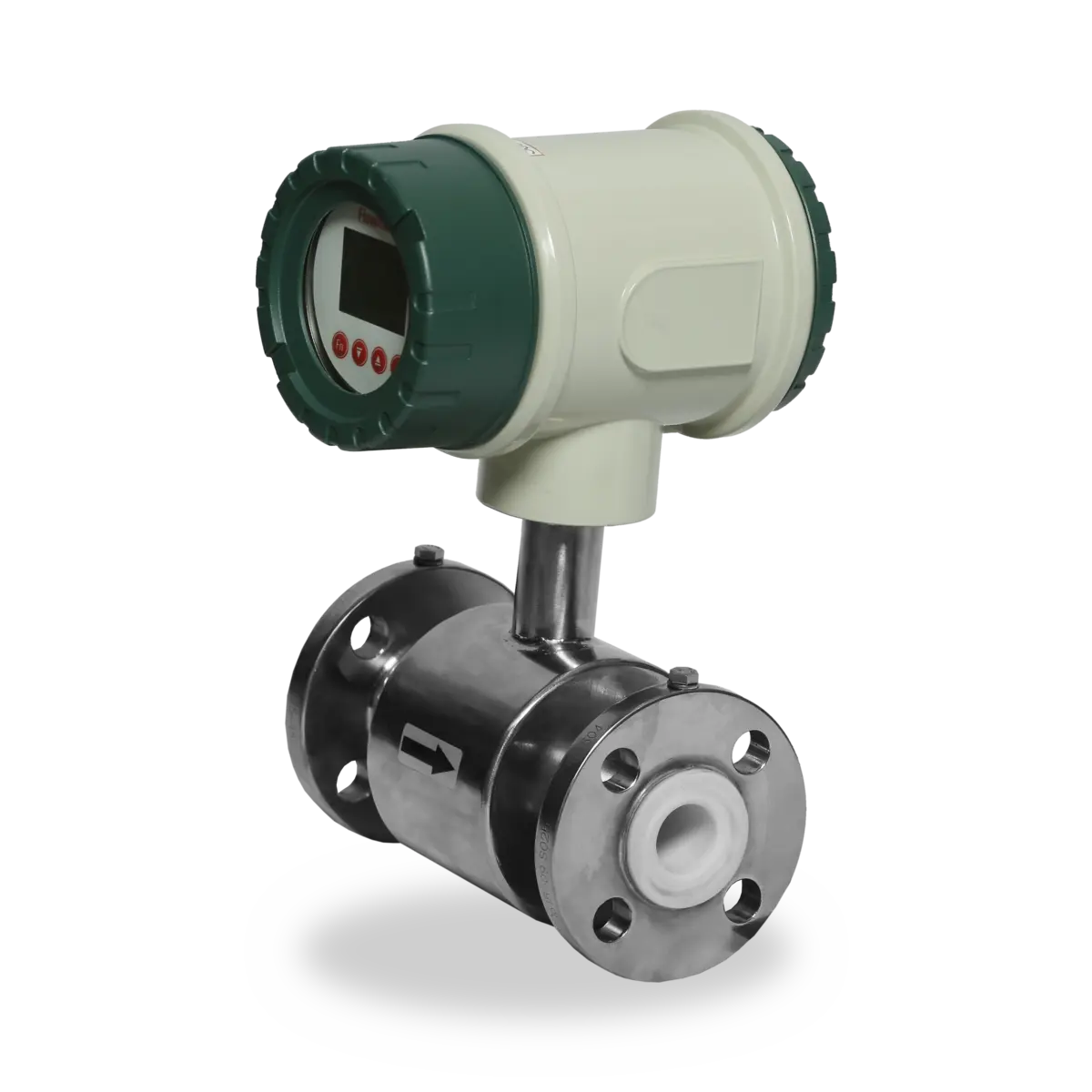
An electromagnetic flowmeter, also known as a magmeter, is a device that measures the flow rate of conductive fluids (liquids or slurries) by inducing a magnetic field and detecting the voltage generated as the fluid passes through it. It's commonly used in industries such as water and wastewater management, chemical processing, and the food and beverage industry.
Water and wastewater treatment, chemical processing, food and beverage industry, pulp and paper industry, pharmaceuticals, mining and slurries, oil and gas, power generation, and HVAC (heating, ventilation and air conditioning).
Click any industry to see the full product list for it, or tell us your process and we will confirm the match.
Yes — it needs a conductive fluid, reliable from as little as 1 µS/cm, which covers essentially all water-based and most process liquids. It won't work on hydrocarbons or other non-conductive fluids — see the Turbine or Oval Gear ranges for those.
±0.5% or 1% FSD accuracy, 0.2% repeatability, covering 0.25 to 2,500 m³/hr in a single meter family.
PTFE, PFA or rubber lining; electrodes in SS316, Hastelloy, Tantalum, Titanium or Platinum — chosen to match the fluid's corrosivity.
No — there's no obstruction in the flow path and nothing mechanical to wear, which is why maintenance requirements are low and it handles bi-directional flow without extra hardware.
Up to 60 Bar working pressure, -20° to 120°~180°C depending on lining, in SS-304, SS-316 or on-request housings.
It depends on the pipe. On bare, conductive metal pipe that's already properly earthed, the pipe itself gives the fluid a reference to ground and a separate ring usually isn't needed. On plastic pipe, or metal pipe with an insulating lining or coating, there's nothing to tie the fluid's potential to ground — fit grounding rings on both sides of the meter, or use grounding electrodes, or the reading will drift or go noisy. Also check continuity across any nearby flanges and gaskets: an insulating gasket can break the ground path even on metal pipe.
Two usual causes. Installation too close to a valve, tee or pump creates turbulence and entrained bubbles right at the electrodes, which shows up as erratic, jumping values — keep the meter away from fittings that disturb the flow profile. The other is electrical noise from nearby VFDs, large motors or poor cable routing coupling into the signal wires, since the raw signal from the electrodes is only a few millivolts; route signal cable away from power cabling and keep cable runs as the manual specifies.
| Model | Line Size | Range |
|---|---|---|
| BT-MFT-015 | 15 mm | 0.32 ~ 05.09 m³/h |
| BT-MFT-020 | 20 mm | 0.57 ~ 09.05 m³/h |
| BT-MFT-025 | 25 mm | 0.88 ~ 17.67 m³/h |
| BT-MFT-032 | 30 mm | 1.45 ~ 28.95 m³/h |
| BT-MFT-040 | 40 mm | 2.04 ~ 40.83 m³/h |
| BT-MFT-050 | 50 mm | 3.53 ~ 70.69 m³/h |
| BT-MFT-065 | 65 mm | 5.61 ~ 112.22 m³/h |
| BT-MFT-080 | 80 mm | 9.05 ~ 180.96 m³/h |
| BT-MFT-100 | 100 mm | 14.14 ~ 282.74 m³/h |
| BT-MFT-150 | 150 mm | 33.96 ~ 679.29 m³/h |
| BT-MFT-200 | 200 mm | 57.69 ~ 1153.71 m³/h |
| BT-MFT-250 | 250 mm | 97.04 ~ 1940.86 m³/h |
| BT-MFT-300 | 300 mm | 127.23 ~ 2544.69 m³/h |
Choose the options you need. Every selection is included automatically when you send the request — so the price you get back is for the unit you actually want.