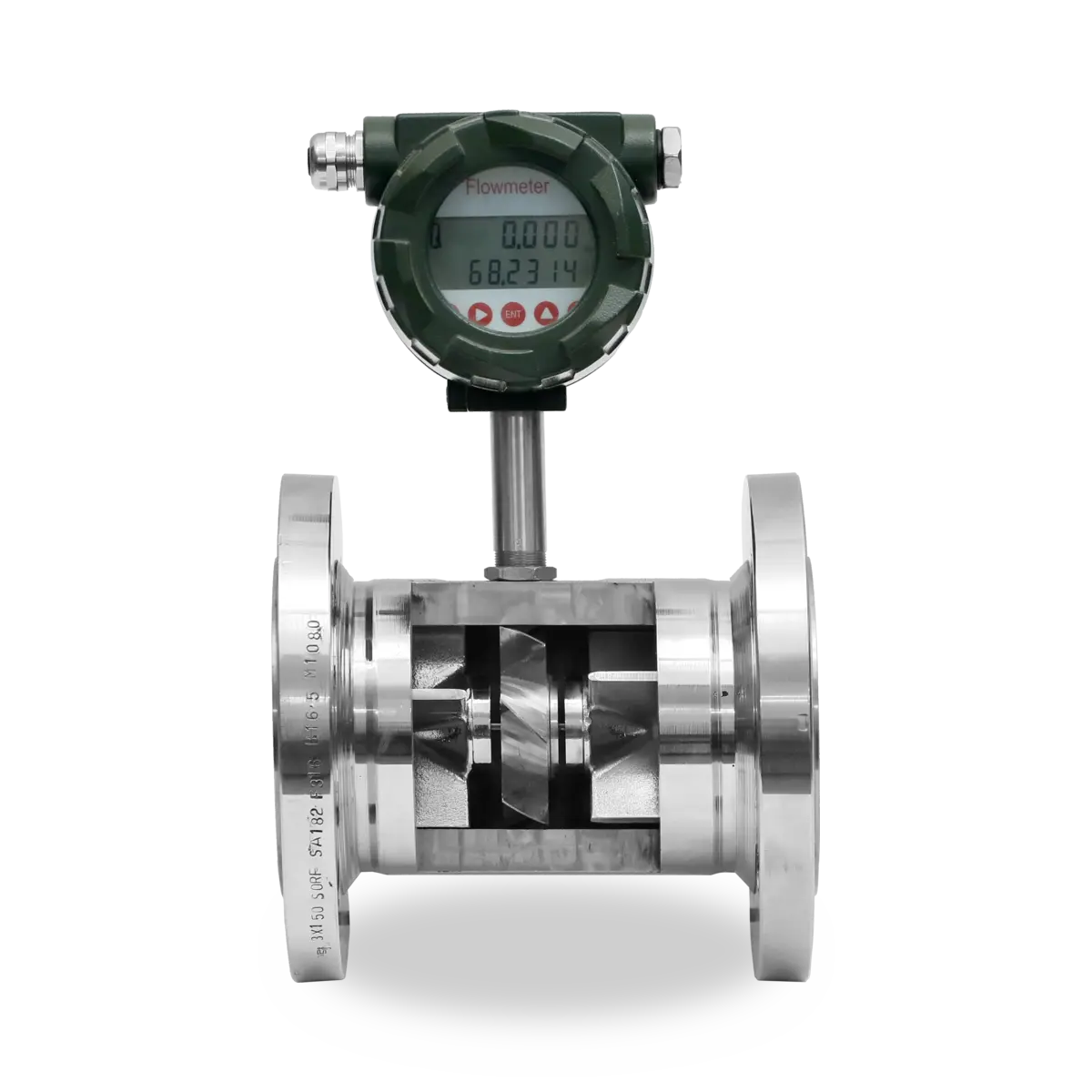
Helical rotor positive displacement flow sensor and meter, specially designed to replace oval gear flow sensors in applications where the liquid isn't pure and an easy, low-weight meter is required — with a favorable low pressure-drop behavior, perfectly suited to very high-viscosity fluids across wide measuring ranges, high accuracy and resolution.
Light and heavy fuel oils, thixotropic fluids, hydraulics test rigs with varying viscosities and fluids, crude oil, furnace oil, and all viscous liquids — even where viscosity changes with temperature. Excellent for laminating systems, painting systems, adhesive dispense systems and batching systems.
Click any industry to see the full product list for it, or tell us your process and we will confirm the match.
It's built to replace the oval gear specifically where the liquid isn't guaranteed pure — the helical rotor tolerates minor contamination and is lighter and easier to service, at a small cost in repeatability (0.15% vs oval gear's 0.01%).
Accuracy is ±0.5% or 1% FSD depending on model, repeatability 0.15%, across a range of 3 to 15,000 L/min, rated to 400 Bar working pressure.
No — it stays accurate independent of viscosity from 1 to 1000 mm²/s, which is why it's specified for crude oil, furnace oil and other thixotropic fluids where viscosity shifts with temperature.
NPN/PNP pulse output at 5/12/24 V DC as standard; see General Specification above for the electrical thresholds.
Flow tube in SS-304, SS-316 or on request; rotor in Cd4MCu or SS410 with Teflon coating; hard-carbon shaft and bush; thread, sandwich flange or Tri-Clamp (Tc) end connections.
No. "Tolerates minor contamination" means the odd trace of grit or moisture in an otherwise-working fuel won't stop the rotor turning — it doesn't mean the meter is immune to welding slag, thread tape or larger debris on a newly installed line. Fit a basic strainer and flush a new or modified pipe run before the meter sees flow, the same as you would for any positive-displacement meter.
Don't run it dry for any length of time. Like any rotor-based positive-displacement meter, the fluid itself is what lubricates and seals the rotor against the housing — running dry, or starting up on a line with trapped air, lets the rotor spin against the bore without that film and accelerates bearing wear. Open the downstream valve first, then bring the line up to pressure gradually so the meter fills before it's asked to measure anything.
| Model | Line Size | Range | Liter / Pulse |
|---|---|---|---|
| BT-HTFS-012 | 12 mm | 400 ~ 4000 L/H | 0.001818 |
| BT-HTFS-020 | 20 mm | 800 ~ 8000 L/H | 0.005263 |
| BT-HTFS-025 | 25 mm | 1000 ~ 10000 L/H | 0.010101 |
| BT-HTFS-032 | 32 mm | 1500 ~ 15000 L/H | 0.020833 |
| BT-HTFS-040 | 40 mm | 2000 ~ 20000 L/H | 0.041666 |
| BT-HTFS-050 | 50 mm | 4000 ~ 40000 L/H | 0.080000 |
| BT-HTFS-080 | 80 mm | 10000 ~ 100000 L/H | 0.32260 |
| BT-HTFS-100 | 100 mm | 20000 ~ 200000 L/H | 0.476190 |
| BT-HTFS-150 | 150 mm | 30000 ~ 300000 L/H | 0.625000 |
| BT-HTFS-200 | 200 mm | 40000 ~ 400000 L/H | 1.000000 |
Choose the options you need. Every selection is included automatically when you send the request — so the price you get back is for the unit you actually want.