
Inside BROIL's digital flow meters
Power options, compensation, and every output a control system might ask for — what actually separates a digital meter from the mechanical one it replaces.
What digital buys you
A digital flow meter measures the same physical event a mechanical one does. What changes is what happens to the reading afterwards. BROIL builds intelligent digital versions of the oval gear, turbine, helical rotor, vortex, thermal mass and swirl meters, and across all of them the gain is the same: better accuracy, real-time monitoring and data logging instead of a number on a dial that someone has to walk over and write down.
That matters because accurate flow measurement is rarely an end in itself. In pharmaceutical production it underpins consistent manufacture of medicines. In water management it is how usage gets monitored and controlled. In both cases the value is in acting on the number quickly, and an instantaneous reading is what makes that possible.
Modern units carry digital displays for easy reading, advanced sensing for accuracy, and — on applicable models — pressure and temperature compensation. Connectivity options let the meter feed a data-logging system so the readings support analysis rather than just a spot check.
Power supply options
Power is often the first constraint on where a meter can go, so the range covers three:
| Supply | Best for |
|---|---|
| Battery operated | Remote locations with no convenient mains supply. Flexible to site and quick to install. |
| 24 V DC | Permanent installation inside a panel-fed process line. |
| 230 V AC | Permanent installation with reliable continuous operation in an industrial setting. |
Pressure and temperature compensation
Pressure and temperature both change how a fluid behaves, and that feeds straight through into the flow reading. A meter with inbuilt pressure and temperature compensation corrects for the variation rather than reporting it as flow.
For anyone running complex fluid dynamics — gases, liquids and mixtures where precise volumetric or mass flow is required — this is what separates a number you can control a process with from one you have to interpret. It also supports compliance, because the accuracy is held across the operating envelope rather than only at the calibration point.
Communication and integration
A meter that cannot talk to your control system is a meter someone has to read manually. BROIL's digital units support the protocols an industrial plant actually runs on:
- RS-485 — reliable data transmission over long distances, which suits large facilities and remote monitoring.
- 4–20 mA — the analogue standard for feeding flow data into a control system.
- HART — bidirectional, so the meter can be configured and diagnosed remotely, not just read.
- Pulse output — a countable signal, the basis of totalising and batching.
- Alarm output — crosses a threshold and the meter itself triggers the response.
That last one is worth dwelling on. If flow exceeds a set limit, an alarm output signals operators or an automated system to act immediately, which can head off a failure rather than record it. A manufacturing plant feeding flow data into a central monitoring system gets real-time analysis; a water treatment site monitoring flow remotely gets to make adjustments at the point they are needed.
The measurement principles on offer
Digital is a layer over the measurement, not a replacement for choosing the right one:
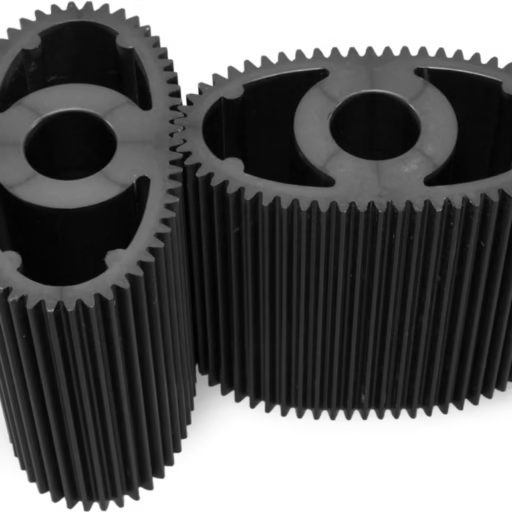
- Digital oval gear — two oval gears rotate in the flow, displacing a fixed volume. Excels with high-viscosity liquids, which is why food processing and cosmetics rely on it.
- Digital turbine — a rotor turns with the stream and speed becomes the measurement. Efficient for low-viscosity liquids and common in oil and gas, with high accuracy and fast response.
- Vortex — reliable across gases and steam, with a wide operational range that suits HVAC and general industrial duty.
- Thermal mass — works on heat transfer and is proficient with gases, holding accuracy even where temperature and pressure fluctuate. Preferred where inert gas measurement is needed.
- Electromagnetic — pivotal in water treatment, where precise measurement of conductive fluids is essential.