
Micro, mini and major: choosing a BROIL flow sensor
Flow sensors are graded by the volume they have to read, not by the industry they sit in. Here is how the micro, mini and major ranges divide up, and where each one belongs.
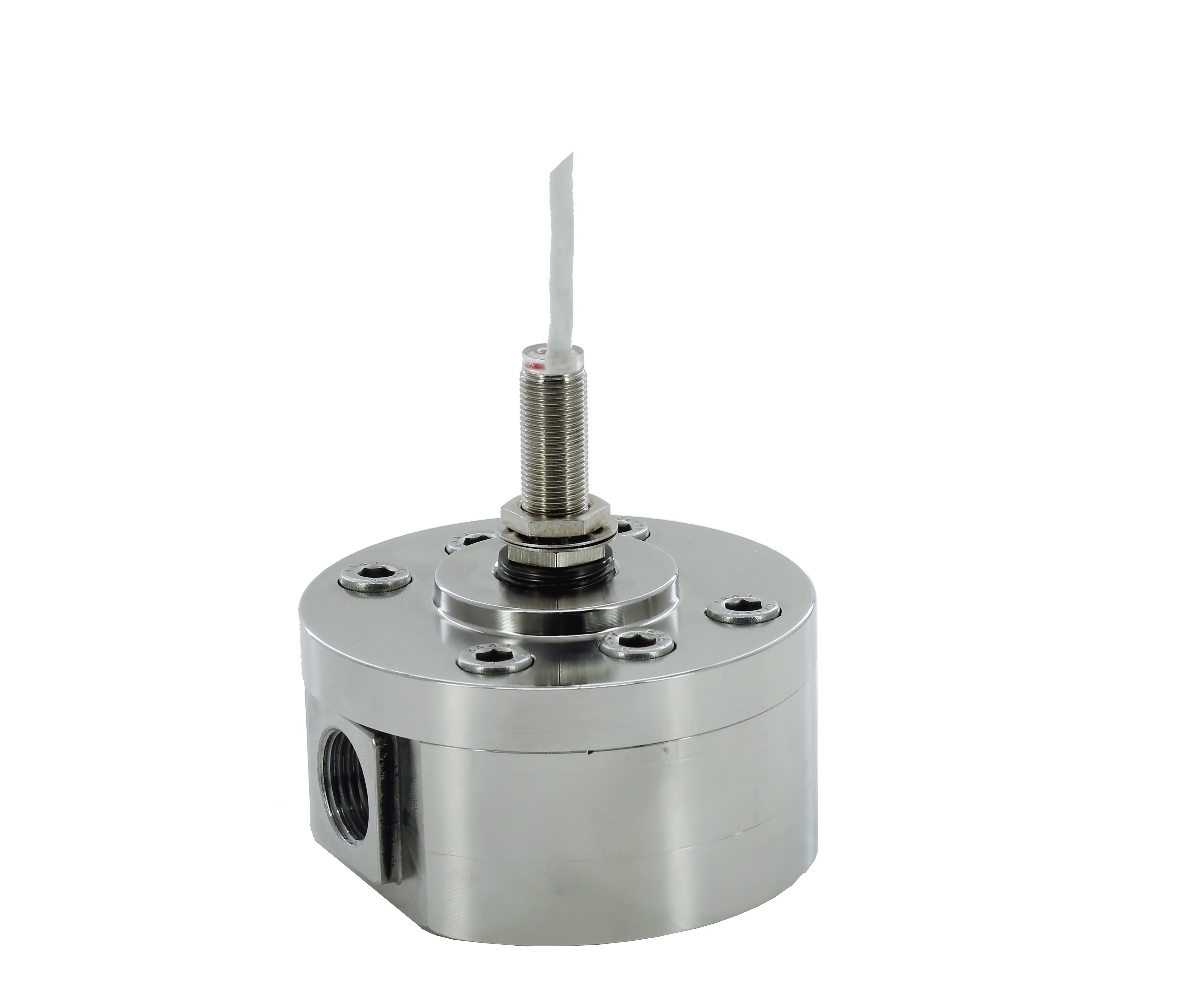
One family, three flow bands
BROIL builds oval gear and turbine flow sensors across three flow bands — micro, mini and major. The measuring principle stays the same inside each; what changes is the chamber volume, the rotor mass and the resolution of the pulse output. That is why a sensor sized for a laboratory dosing line and one sized for an irrigation header look related but are not interchangeable.
The oval gear sensor is a positive-displacement device: two interlocking oval rotors trap a known volume with every turn, so the count is a direct measure of volume passed. It is accurate and stable, and it copes with viscosity, which is why it dominates in chemical processing, food and beverage, and oil and gas.
The turbine sensor works the other way round. A rotor spins in the stream and its rotational speed is converted into an electrical signal. It is a velocity device, which makes it fast and well suited to clean, low-viscosity liquids.
Mini sensors: 6 to 300 L/h
Mini sensors are the workhorses of the range — compact bodies covering roughly 6 to 300 litres per hour. That band is wide enough to serve very different sectors without changing technology, running on either oval gear positive displacement or a turbine or helical rotor depending on the fluid.
In food and beverage production a mini sensor monitors ingredients during mixing so a batch stays inside its quality window. In chemical processing it regulates reagent flow, which is what gives you control over the reaction itself. Both cases need accuracy held over long runs rather than a headline figure on a datasheet.
Two practical advantages matter as much as the accuracy. The small body drops into an existing line without redesigning the pipework, so retrofitting causes very little disruption. And improvements in materials and sensor construction have made these units far more resistant to corrosion, which widens what you can safely put through them — including viscous and aggressive fluids that would once have ruled the technology out.
Micro sensors: below 3 L/h
Micro sensors handle the flows most instruments cannot see at all — from under 0.1 up to about 3 litres per hour. At that scale, the challenge is not reading the flow but reading it repeatably, batch after batch, with fluids that may be delicate or expensive.
They use the same oval gear or helical rotor principles, shrunk down, with a footprint small enough to build into a compact assembly. Most give a linear output that tracks flow rate directly, which keeps interpretation simple, and many carry a digital interface so the reading drops straight into an automated system for live monitoring.
Laboratories use them for precise measurement while handling delicate samples in chemical synthesis and analytical work. Pharmaceutical production uses them in drug formulation and testing, where holding a consistent flow rate has a direct effect on product quality. They also hold up in awkward conditions — high-viscosity fluids and varying temperatures.
Major sensors: 50 to 300,000 L/h
At the top of the range, major sensors read from 50 up to 300,000 litres per hour. High-volume measurement is less about fine resolution and more about staying accurate while a lot of fluid moves quickly, and about surviving the environment it moves through.
In agriculture they monitor water use and irrigation, and that data is what lets a grower manage the resource deliberately rather than by habit. In waste management they track wastewater flow so treatment stages run efficiently and discharge stays inside environmental limits. In large-scale manufacturing they measure raw material and finished goods in transit, feeding inventory management and logistics planning.
They also scale with demand. Where flow rate fluctuates through the day or the season, a major sensor keeps its accuracy across the swing rather than only at its design point — and predictive maintenance and remote monitoring features mean you find out about a developing problem before it stops production.
Picking the right band
| Band | Flow range | Typical use |
|---|---|---|
| Micro | < 0.1 – 3 L/h | Laboratory dosing, pharmaceutical formulation, analytical work |
| Mini | 6 – 300 L/h | Food and beverage batching, chemical reagent control, HVAC, automotive |
| Major | 50 – 300,000 L/h | Irrigation, wastewater, bulk manufacturing transfer |
Start from the flow you actually expect at normal running — not the maximum the pump could theoretically deliver — then check the fluid's viscosity and whether it is clean. Those two answers usually decide both the band and whether you want positive displacement or velocity.