
Why oval gear sensors dominate fuel and oil measurement
Two interlocking rotors, a fixed volume per turn, and a pulse you can send anywhere. The reason this design has not been improved on for OEM fuel and oil duty.
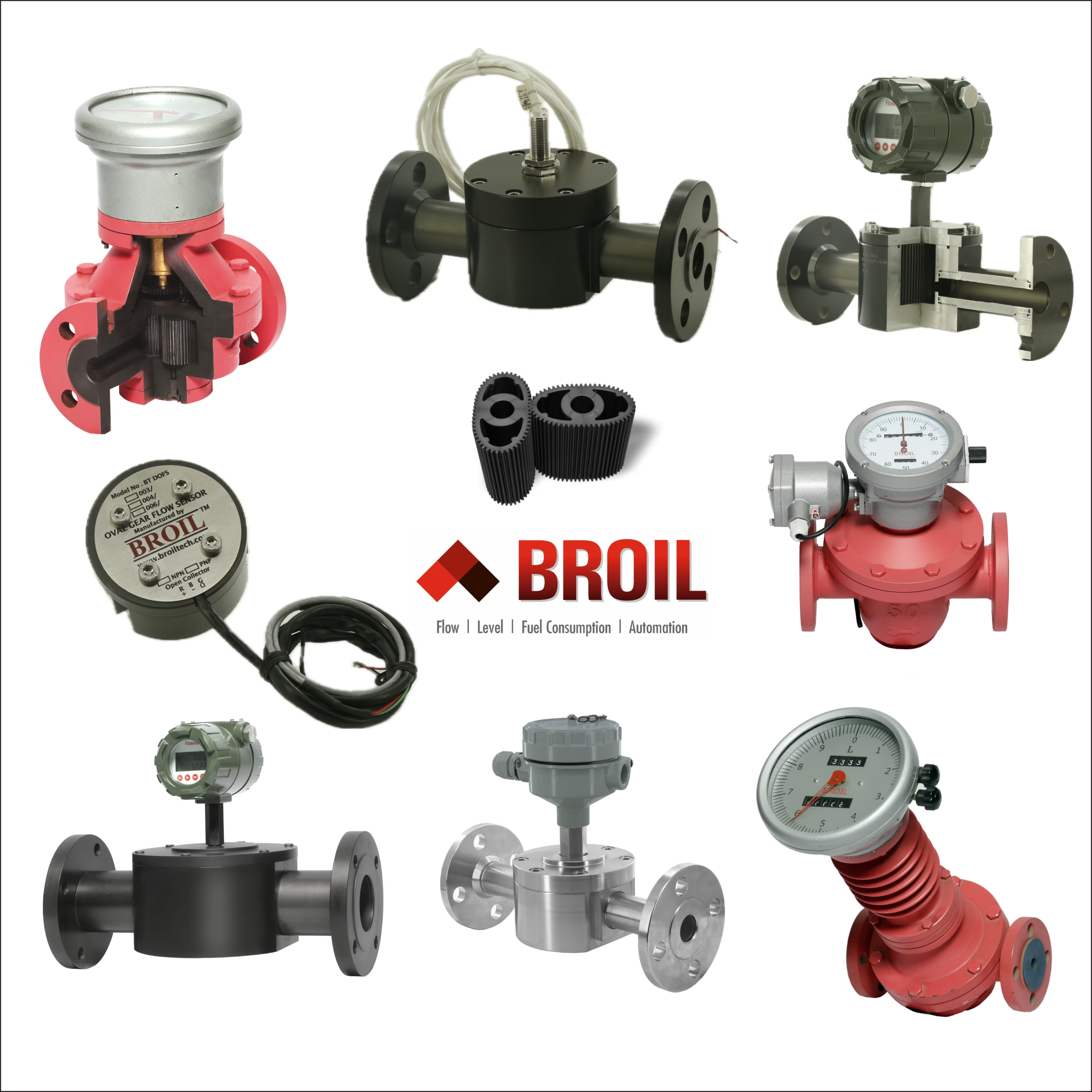
How the measurement works
Positive displacement flow sensors capture a specific volume of fluid and count it over time. That is the whole principle, and it is why they are precise: the measurement is the volume, not an inference from velocity.
The oval gear variety uses two interlocking oval gears rotating within a fixed casing. Fluid entering the sensor drives the gears, and every complete rotation corresponds to a specific volume passing through. That mechanical arrangement captures minute variations in flow that other sensor types miss, and it accommodates a wide range of fluid types and conditions — which is exactly what you need in a challenging environment.
It is especially effective for fuel and oil with varying viscosities, which is where a velocity-based sensor starts to struggle.
What BROIL adds
The distinguishing feature of BROIL's oval gear sensors is the pulse output. A pulse is countable, which makes it trivial to totalise, and it transmits cleanly over distance, which makes remote data control and process monitoring practical rather than aspirational.
Real-time transmission means flow rates can be monitored and analysed from a distance, so someone overseeing a production process gets to act on what is happening now instead of reviewing it later. That is where the accuracy actually pays off.
Every sensor is tested before it ships, for performance and durability, and customised where the application requires it. The attention at that stage is what minimises downtime and maintenance cost later.
OEM applications
Oval gear sensors are a mainstay in original equipment manufacturer work, particularly in liquid filling machines and bottling equipment, where precise measurement is what quality control depends on. Their ability to detect low flow rates accurately is the specific reason OEMs choose them.
Food. They fill beverages, sauces and oils. Dispensing the correct volume promotes consistency and quality, and supports compliance with food safety standards. Handling viscous liquids without losing accuracy is what makes them indispensable here.
Fuel and oil. They measure different grades of oil in refining and distribution. Reliability reduces the downtime caused by measurement error, and real-time data improves decisions during production cycles.
Pharmaceutical. Filling machines use them where accuracy is paramount, dispensing medicinal liquids to strict dosage regulation.
Why it holds up
The primary benefit is accurate flow measurement, which is what maintains operational efficiency and product quality. The pulse output improves that further by relaying data in real time, which reduces waste and, in practice, improves profitability.
For OEMs, the robust construction is the other half of the argument: minimal downtime and low maintenance need, which preserves the efficiency of the whole machine it sits inside.
Specifications and model ranges are on the oval gear flow sensor and meter page, and units are available to order in the shop.